Table Of Content
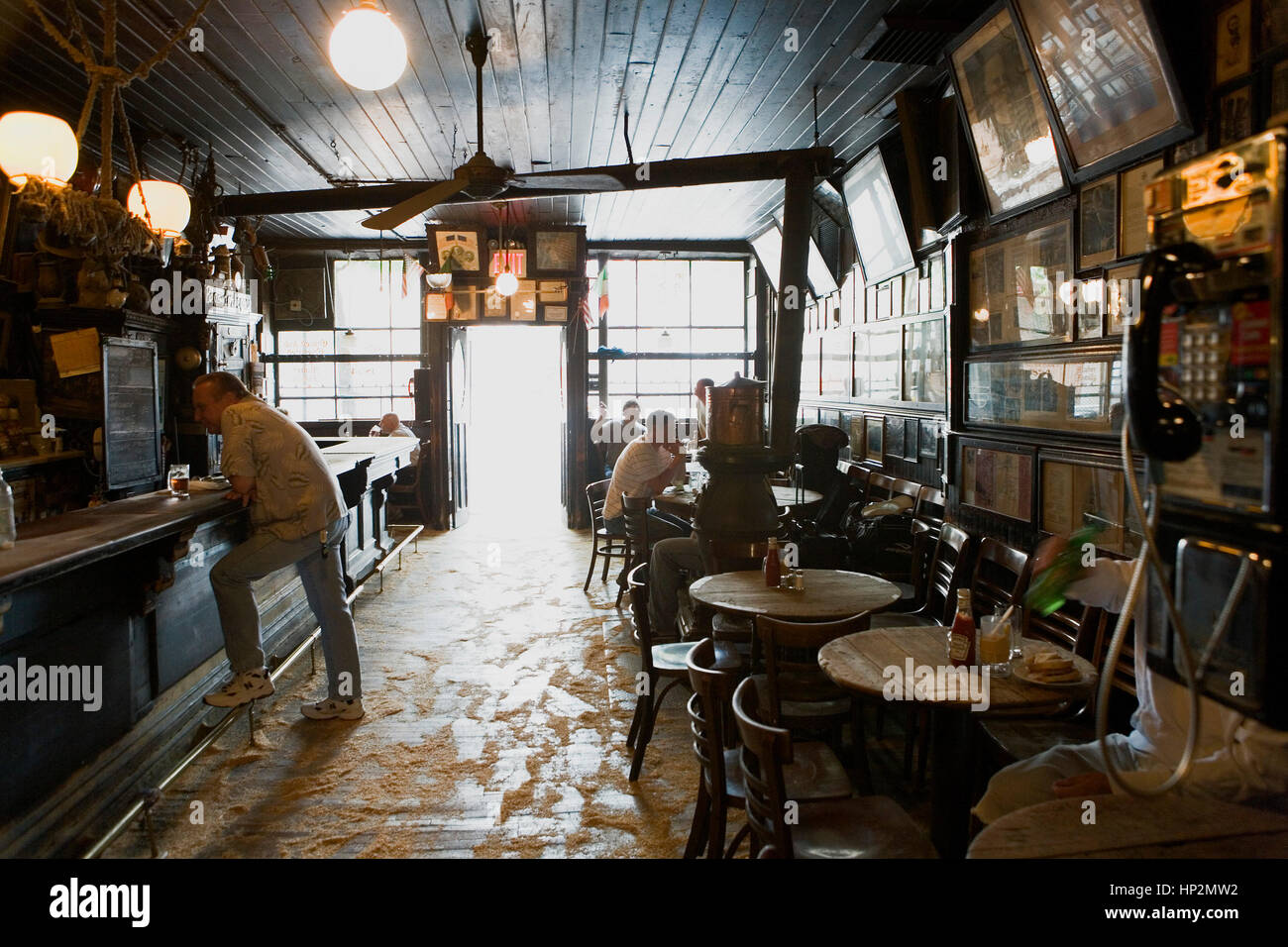
Many others have tried to mimic its old-school attitude and its no-nonsense approach, but none come close to the real deal. The bar has remained a part of East Village history, and has been actively shaped by American political discourse over time. Originating as an Irish "workingman's saloon," the bar is a historic landmark both to the Irish community and the city of New York. McSorley’s Old Ale House is one of New York City's oldest bars and is full of rich history to prove it.
Food and drinks – what’s on offer in New York’s oldest Irish bar
Sometimes, in the afternoon, if the weather was good, he would shuffle into the bar, a sallow, disenchanted old man, and sit in the Peter Cooper chair with his knotty hands limp in his lap. For hours he would sit and stare at the painting of Old John. The customers were sure he was getting ready to die, but when he came in they would say, “You looking chipper today, Billy boy,” or something like that. He rarely spoke, but once he turned to a man he had known for forty years and said, “Times have changed, McNally.” “You said it, Bill,” McNally replied. As close as his friends could figure it, his age was seventy-six.
The 20 Best Bars In NYC To Celebrate St. Patrick's Day - Tasting Table
The 20 Best Bars In NYC To Celebrate St. Patrick's Day.
Posted: Mon, 18 Mar 2024 07:00:00 GMT [source]
McGillin's Olde Ale House kicks off year-long celebration in honor of bartender's 50th work anniversary
In 2011, the two dozen wish bones were finally dusted off and cleaned in response to health inspectors' orders. McSorley's Old Ale House is one of the oldest bars in New York City. Established in 1854, the bar still serves its signature ale and sits in the same location as it did from the beginning. The poster is joined in the pub by a pair of handcuffs used by escapologist Harry Houdini and a pair of shackles belonging to a prisoner during the American Civil War.
Opened to women
When John McSorley made his epic journey from Dublin, Ireland to New York with his wife Mary, he may have only imagined his tavern would become a hallmark of the city for the next 150 plus years. In New York City, taverns come and go and few may stand the test of time. Some have occupied their lots longer than McSorley’s, like the Ear Inn at 326 Spring Street or Fraunces’ Tavern at 54 Pearl—one of the oldest remaining structures in Manhattan, dating as far back as 1785. Yet few establishments will maintain their original spirit like McSorley’s saloon, a spirit, still carried forward and owned by the Maher family. Though its wooden walls and doors may be etched and notched by wear, its beauty and nostalgia endure in the smooth ale poured and the patrons who were there—lending truth to its motto, we have been here before you were born.
He’s in favor of blowing up every bank in the country.” “So am I,” said Bill. He owned as many as eighteen at once and they had the run of the saloon. He fed them on bull livers put through a sausage grinder and they became enormous. When it came time to feed them, he would leave the bar, no matter how brisk business was, and bang on the bottom of a tin pan; the fat cats would come loping up, like leopards, from all corners of the saloon. Although Old John did not consider himself retired until just a few years before he died, he gave up day-in-and-day-out duty back of the bar around 1890 and made his son, William, head bartender.

McSorley's Old Ale House
In those days, one(s) was especially careful to behave decently in front of a lady. In 1939, when then-owner Daniel O’Connell died and left the bar to his daughter, Dorothy O’Connell Kirwan, she honored the no-women policy and appointed her husband as manager. When the bar celebrated its centennial, Kirwan had her celebratory drink outside on the sidewalk. After women were finally admitted, Kirwan declined to be the first woman served, a decision that makes more sense if you know that the first women’s restroom wasn’t added until 16 years later. The pub is the oldest in town (opened in 1854) and best of all, not much has changed since then.
I am lucky enough to have once been a patron and to have experienced the vast history amongst the walls of the old ale house. Bill was deaf, or pretended to be; even so, ordinary noises seemed to bother him unduly. The method he devised to keep the saloon tranquil was characteristic of him.
Tilden might have pondered the same, when he lost that year’s election in 1876 to Rutherford B. Hayes. McSorley’s is famed to be one of the last men’s only clubhouses. Yet from its ardent grip of the status quo, the tavern still stood on the cusp of social change—if only reluctantly so—by losing a case heard before the Supreme Court in 1970. McSorley’s was then forced to serve female patrons, and there is no doubt this forever changed the social bar scene in New York City. At a time when many establishments in the south may have still served whites only, the historic tavern served African-American poet, drama, and music critic Everett LeRoi Jones who died January of last year. At 15 East 7th Street, located in the shadow of The Cooper Union is McSorley’s Old Ale House, an enduring remnant of the city’s rich culture, history, and the embodiment of the American dream.
Supposedly, the ashes of up to four other individuals are covertly housed at the near end of the bar, close to the main door. Why do some people get the honor of resting behind the bar forever while others get scattered amongst the sawdust? The standards for being laid to rest behind the bar are quite rigorous. You have to be a regular of the pub for over 40 years in order to be placed across from Old John’s likeness. However, about two dozen wishbones remain on that lamp rail over the bar—one for each of the neighborhood men who never made it back from France.
Old wooden floors covered with sawdust, old newspaper articles and a bartender like from a Hollywood movie make McSorley’s a very relaxed place. The lawsuit compelled New York City Mayor John V. Lindsay to sign an executive order prohibiting discrimination on the basis of sex in bars and other public accommodations. At 3pm the next day, McSorley’s opened its doors to women for the first time.
Historians credit the Cooper Union Address as the turning point in Lincoln’s campaign. It helped him vault over his rival Stephen A. Douglas to secure the nomination as the Republican presidential candidate. "Every day is a blessing. I'm healthy, I feel good," Doyle said.
The only other drink available, in addition to the two ales, is soda, and a limited, reasonably-priced food menu is posted daily on two chalkboards. There are no TVs at McSorley’s and no ambient music—the only noises you’ll hear are the clinking of glasses and the muted hum of people’s conversations. Unlike the drinks, which are slammed on the bar seconds after ordering, change arrives slowly at McSorley’s.
On these days the smell of malt and wet hops would be strong in the place. Kelly’s product was raw and extraordinarily emphatic, and Bill made a practice of weakening it with near beer. In fact, throughout prohibition Bill referred to his ale as near beer, a euphemism which greatly amused the customers. One night a policeman who knew Bill stuck his head in the door and said, “I seen a old man up at the corner wrestling with a truck horse. I asked him what he’d been drinking and he said, ‘Near beer in McSorley’s.’ ” The prohibition ale cost fifteen cents, or two mugs for a quarter. If these picture-filled walls had ears they might have heard, William “Boss” Tweed, the infamous New York politician and mogul of Tammany Hall, hatch his scheme to pilfer millions of taxpayer funds.
“Not a day goes by without someone coming in and starting a conversation with, ‘The last time I was in here…’” Buggy says. It’s also easy to imagine who hasn’t visited McSorley’s over the years. It wasn’t until 1970 that women were finally allowed inside. The pub, whose motto was “Good Ale, Raw Onions, and No Ladies,” was not yet ready to get with the times. In fact, they fought hard to keep women out of the establishment and even considered becoming a private club to do so. When he died in 1883, his chair was retired and still sits behind the bar.
Shaum was allowed into McSorley’s after the passing of an ordinance which forbid discrimination based on sex within the city. At the very least, McSorley’s can claim the title of “oldest Irish pub” in the city. It’s no surprise that McSorley’s—with its green, shamrock-emblazoned storefront—is a popular destination on St. Patrick’s Day. During World War I, McSorley’s offered all US troops a turkey dinner before deployment. It became tradition for the soldiers to leave the turkeys’ wishbones in the pub to be snapped upon their return. Once again, a story can be told by what you won’t find at McSorley’s.


No comments:
Post a Comment